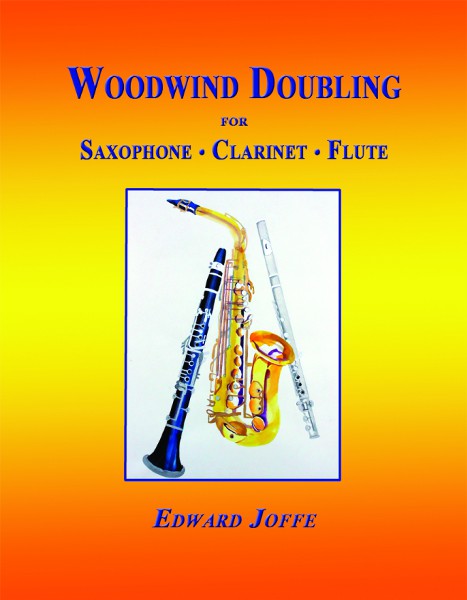
The newly revised 2022 edition of Woodwind Doubling for Saxophone, Clarinet & Flute is an expanded 436-page comprehensive study of the art of multiple woodwind performance divided into four parts—Historical, Pedagogical, Musical Excerpts, and Essential Resources. This edition includes a new chapter on equipment; a new section on “Playing In Tune”; an enhanced study of the breathing process; additional transcriptions, musical exercises and historical photos; up-to-date information on the hiring prospects for woodwind doublers; and an expanded list of recommended recordings and study materials for multi-woodwind performers. Endorsed by woodwind artists such as Gary Foster, Ted Nash, Dick Oatts, Dan Higgins and Lawrence Feldman, Woodwind Doubling for Saxophone, Clarinet & Flute examines each of these areas in great detail and offers the aspiring “doubler” as well as the seasoned professional insight into a sector of the music industry that has previously received little or no attention in the media or press. Interviews with noted doublers from across the U.S., extensive research, and the author’s own experience from over forty-five years as a successful New York woodwind performer and music educator has served as the basis for this work. This book has become a source of reference internationally in eleven countries.
Part One traces the evolution of the woodwind multi-instrumentalist from its origins in 14th Century Europe to the 19th Century invention of the saxophone and ultimately to the role that the saxophone and its practitioners played in establishing woodwind doubling in 21st Century America. An examination of the current state of the music industry and the doubler’s prospects for employment is presented.
Part Two deals with several aspects of performance and study. Efficient, ergonomic approaches for the saxophone, clarinet and flute family of instruments is offered along with specific exercises to improve one’s breathing efficiency, embouchure development, articulation, vibrato, and tone production. Recommendations for how to study, practice and play “in tune” are provided along with a discussion of mouthpieces, ligatures, headjoints, pads, barrels, bells, straps, etc. This section concludes with an in-depth discussion of reeds—the process for selection, preparation, adjustment and preservation. Musical excerpts are provided as a means for gauging one’s success during the adjustment process.
Part Three involves musical excerpts from commercial, jazz, classical, rock and pop idioms with specific advice on how to achieve success in executing these styles. This section concludes with transcribed solos by some of the greatest woodwind performers which serve to demonstrate the levels of musical sophistication required of doublers.
Part Four outlines essential study materials, necessary gig equipment, woodwind artists to study in diverse musical styles, recommended recordings, and tips for succeeding as a woodwind multi-instrumentalist. A forty-year retrospective of Broadway musical orchestrations with emphasis on the use of woodwinds is given in order to help the reader understand the prospects and requirements for work in the musical theater.
Purchase at Joffewoodwinds.com
6 replies on “Woodwind Doubling for Saxophone, Clarinet & Flute”
[…] Ed Joffe – Woodwind Doubling for Saxophone, Clarinet & Flute (Book) […]
[…] Ed Joffe – Woodwind Doubling for Saxophone, Clarinet & Flute (Book) […]
[…] Ed Joffe’s Woodwind Doubling Book […]
[…] Sean had expressed an interest in having me on his interview series, I sent him a copy of my book Woodwind Doubling for Saxophone, Clarinet & Flute and CD entitled Contrasts. (Sean is also a doubler of sorts—he plays clarinet and marimba—and […]
[…] Ed Joffe‘s Website contains a complete description of Woodwind Doubling for Saxophone, Clarinet and Flute which is highly recommended by Flute Journal, your editor as well as our reviewer Frank Griffith. […]
[…] Joffe is offering a special course for doublers that may be of benefit to […]